
Published on: Aug 26, 2025
Portal Hypertension I Clinical Nursing Classroom – Class review

Missed the August 2025 Edition of the Clinical Nursing Classroom with DavidTheNurse on Portal Hypertension? Don’t worry! We’ve compiled a summary of the class for your review. Please go through it and share your key takeaways and comments in the section below.
Portal Hypertension is an abnormal elevation of intravascular pressure within the portal system. The normal portal vein pressure is between 7-12 mmHg; any value beyond this upper limit could be a sign of portal hypertension.
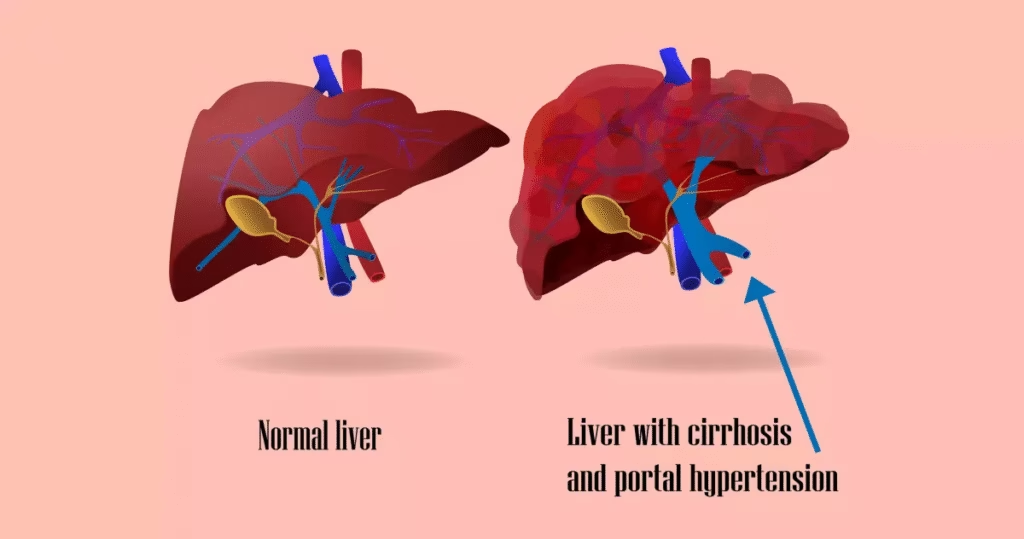
Vector medical illustration of normal liver and cirrhosis with portal hypertension
Portal pressure can be measured directly or indirectly. Direct measurement is invasive and requires direct cannulation of the portal or umbilical veins. Indirect measure requires measuring the Hepatic venous pressure gradient (HVPG) which represents the portal perfusion pressure; a value that predicts adequate blood flow within the portal system. The HVPG ranges from 1 to 4 mmHg. Values greater than 5 mmHg indicate portal hypertension, and values greater than 10 mmHg cam signal clinically significant portal hypertension.
Cirrhosis of the liver has been implicated as the most common cause of portal hypertension. The scarring of the liver parenchyma does two things- sinusoidal distortion and vascular changes. These two combined together cause an increase in intra-hepatic vascular resistance which leads to a cascade of responses, eventually elevating the pressure within the portal circulation.
The HVPG ranges from 1 to 4 mmHg. Values greater than 5 mmHg indicate portal hypertension, and values greater than 10 mmHg cam signal clinically significant portal hypertension.
Some of the complications of portal hypertension include ascites, esophageal varices, Hepatic encephalopathy and hepatorenal syndrome, which lead to substantial morbidity and mortality.
There are also non-corrhotic factors that can cause portal Hypertension. These factors have been classified as pre-hepatic, hepatic and post-hepatic causes. Hepatic causes are further subdivided into pre-sinusoidal, sinusoidal and post-sinusoidal.
Management of portal hypertension can be classified as follows:
- Identify cause
- Symptom Management
- Pharmacological Management
- Surgical Management
- Liver transplant
David Ogunlabi.


Good stuff!
I was not able to join the teaching on Saturday but going through the summary, I’ve learnt a few things about portal hypertension. This is my first time of hearing about it and I’m actually interested in the way liver cirrhosis causes portal hypertension. I want to know how it connects and how it works . Thank you sir
I learnt that portal hypertension can be treated depending on the causes especially if diagnosed on time.
Liver Cirrhosis is a most common cause of portal hypertension.
It can be measured directly or indirectly; directly by an invasive process of cannulating the portal or umbilical vein, and indirectly; by measuring the hepatic venous pressure gradient (HVPG).
Thank you so much for the concise summary.
I had more insight on the pathophysiology of portal hypertension which helped me in my project defence.
Thank you for this.
I really appreciate it.
Insightful!
Wonderful presentation!
Well done, Nr David!
Thank you for summarizing this, I learnt a lot and I understand Portal Hypertension better. I think finish the class but with this summary I know and I understand what other people that attended the class gained.
Wow!!!
This is simplified enough Sir.
I was initially confused about this topic.
Thanks for sharing such an important topic Sir
Ten solid minutes of intensive reading and understand
Great job👍
Thank you very much for the beautiful lecture. I really learnt a lot from the pathophysiology how patient develop oesophageal varices due to back flow of blood from the liver to the intenstine. Ascites due to fluid leakage to the abdominal cavity. Encephalopathy due to ammonia build up as the liver is unable to convert them to urea for excretion due to cirrhosis.
I also learnt about some drugs used for the management e.g octreotide used to control variceal bleeding.beta blockers eg propranolol,carvedilol to reduce portal pressure. Nitrates eg Isosorbide mono nitrate are vasodilators.
Nr David Ogunlabi is a great tutor. I learnt a lot from the class which include the pathophysiology of portal hypertension which is the part I really enjoyed most.
Thank you so much sir for this opportunity.
I will recommend his classes for all nursing students across the world. Trust me the way he explained is top notch🤭
God bless you sir
Insightful
Thanks for sharing sir
I was no able to join the class on Saturday but viewing the summary has arosed my curiosity to go learn more about portal hypertension mostly the non cirrhotic factors.