Published on: Oct 20, 2026
Addressing Unsafe Practices and Medication Errors: Lessons from Mrs. Ronke Awodiya

1. Introduction
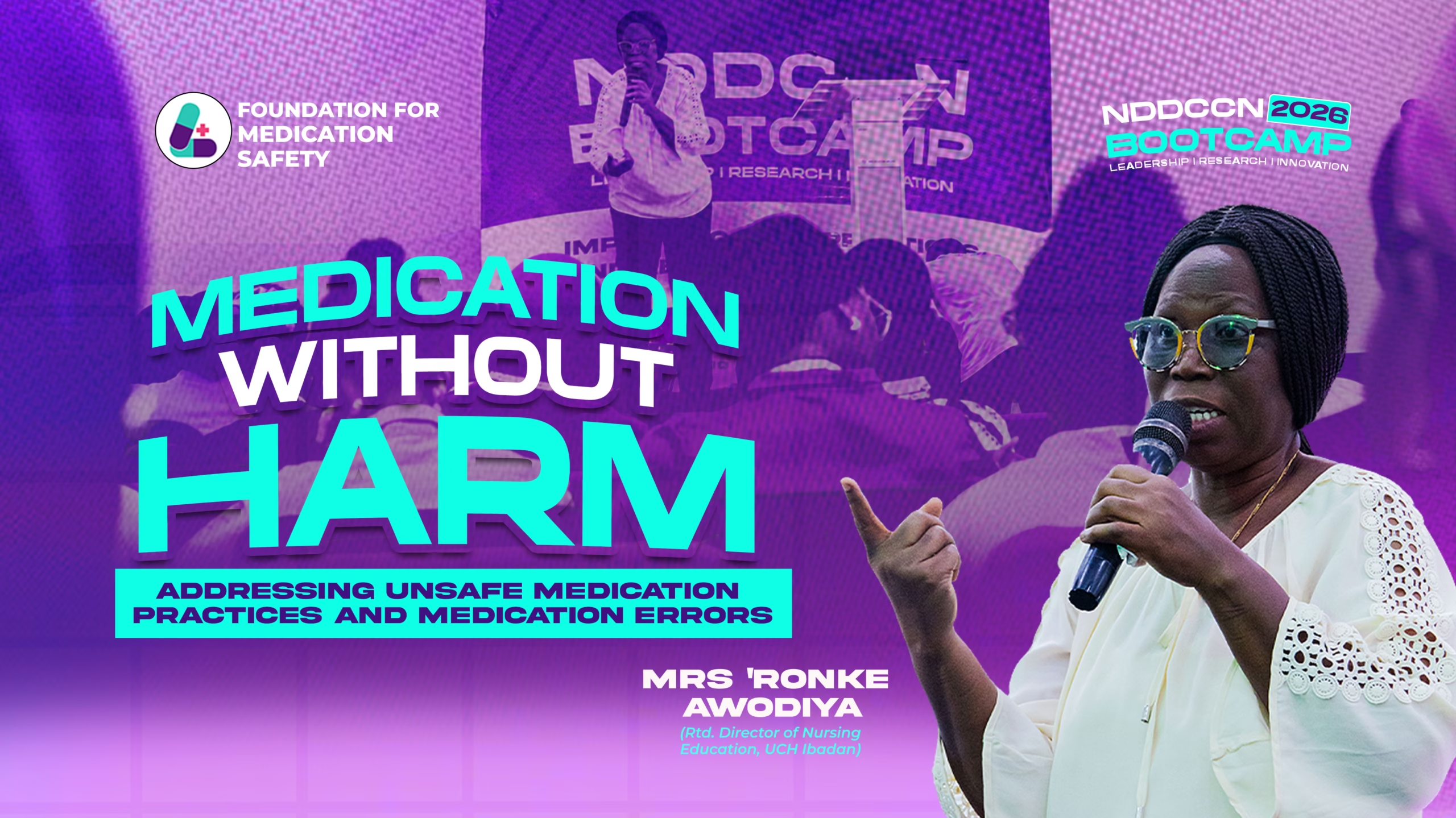
The keynote session at the Foundation for Medication Safety (FMS) NDDCCN 2026 Bootcamp was delivered by Mrs. Ronke Awodiya, a highly experienced nursing professional and former Director of Nursing Education at the University College Hospital, Ibadan. Drawing on approximately 42 years of nursing practice, she delivered a practical presentation on medication safety, unsafe medication practices, and the prevention of medication errors.

Her presentation, titled “Medication Without Harm: Addressing Unsafe Medication Practices and Medication Errors,” emphasised the critical responsibility of healthcare professionals to ensure that medications are used safely, appropriately, and in ways that minimise the risk of preventable harm.
The keynote combined professional knowledge with real-life clinical experiences to demonstrate how errors can occur at different stages of medication use and how nurses can serve as essential safeguards against such incidents.

2. Overview of the Keynote Address
Mrs. Awodiya began by highlighting the importance of continuous learning in nursing, regardless of professional experience or academic level. She encouraged nursing students to develop their knowledge early and reminded participants that learning must continue throughout their professional careers. She also observed that contemporary nursing education has evolved considerably, with extensive curricula potentially leaving gaps in the practical pharmacological knowledge required for safe medication administration.

A central message of the presentation was that the intention to treat a patient does not automatically guarantee a safe outcome. Even when healthcare professionals intend to improve a patient’s condition, inadequate knowledge, inappropriate prescribing, human error, and weaknesses in healthcare systems can result in medication-related harm.
Using experiences from her professional practice, she demonstrated the importance of vigilance, sound clinical judgement, accountability, and the confidence to question medication orders that appear unsafe.
3. Major Themes and Key Messages
3.1. Medication safety and the risk of preventable harm
The speaker explained that medications are used for several purposes, including the prevention, diagnosis, and treatment of diseases, as well as the management of abnormal bodily functions. However, their benefits depend on appropriate selection, prescribing, dispensing, administration, and monitoring.
She emphasised that medications can cause harm when used incorrectly or when healthcare professionals fail to account for individual patient characteristics. The possibility of harm makes medication safety a shared responsibility across the healthcare team.
The presentation reinforced the need for healthcare professionals to understand not only what a medication is intended to achieve but also its potential adverse effects, contraindications, dosage requirements, and implications for individual patients.
3.2. The consequences of inadequate pharmacological knowledge
Mrs. Awodiya expressed concern that the demands of contemporary nursing curricula may leave some graduates insufficiently prepared for the practical aspects of medication management.
She stressed that knowledge of pharmacology must extend beyond classroom learning and be applied competently in clinical practice. Nurses should understand the medications they administer, recognise inappropriate doses, identify potential interactions, and assess whether prescribed treatments are suitable for individual patients.
Her message was particularly relevant to nursing students and early-career professionals: clinical competence requires continuous learning, practical application, and the willingness to seek clarification when uncertain.
3.3. Individual patient differences and medication-related harm
The speaker highlighted that patient may respond differently to the same medicine because of variations in age, physiological function, existing illnesses, and other individual factors.
She drew particular attention to two vulnerable groups:
- Neonates and premature infants: These patients require careful medication management because of their developmental and clinical needs.
- Older adults: Age-related changes in organ function, multiple chronic illnesses, and the use of several medications can increase the risk of adverse medication outcomes.
She also identified critically ill patients, individuals receiving emergency or intensive care, and patients moving between departments or care settings as groups requiring heightened attention.
Her discussion demonstrated why medication decisions must be individualised rather than based solely on standard doses or assumptions about patients with similar characteristics.
3.4. The five stages of the medication-use process
Mrs. Awodiya explained that medication errors can arise at several points in the medication-use process. She identified five major stages:
1. Prescribing
Errors may occur when a medicine, dose, or treatment regimen is selected inappropriately for a patient.
2. Transcribing
Errors may arise when medication instructions are copied or transferred incorrectly, including mistakes involving drug names or dosage.
3. Dispensing
Incorrect medications, strengths, or formulations may be supplied, including confusion between medications that look alike.
4. Administration
Errors may occur when the wrong medicine, dose, route, or timing is used, or when essential safety checks are omitted.
5. Monitoring
Failure to assess therapeutic responses, recognise adverse effects, or take appropriate action can allow preventable harm to progress.
The speaker stressed that medication safety does not end when a medicine is administered. Monitoring the patient’s response and intervening when necessary are equally important components of safe practice.
3.5. Human and system factors contributing to medication errors
The keynote identified several contributing factors that may lead to unsafe medication practices.
Human factors include inadequate knowledge, lapses in attention, incorrect calculations, failure to follow established procedures, and reluctance to question potentially unsafe prescriptions.
System factors include staff shortages, inappropriate staffing arrangements, inadequate supervision, insufficient safety checks, and the absence of standardised procedures or supportive technologies.
Patient-related factors include difficulties understanding medication instructions, recognising medications, and managing multiple prescriptions after discharge.
Mrs. Awodiya emphasised that medication safety cannot depend solely on individual vigilance. Healthcare organisations must also establish working conditions, processes, and safeguards that enable professionals to practise safely.
3.6. Ethical principles and professional accountability
The speaker connected safe medication practice with the ethical foundations of healthcare, particularly beneficence and non-maleficence.
- Beneficence: Acting in the patient’s best interests and seeking to promote their well-being.
- Non-maleficence: Avoiding preventable harm.
She explained that these principles must be reflected in everyday clinical decisions rather than remaining theoretical concepts learned during training.
Healthcare professionals must exercise diligence, accept responsibility for their actions, and remain accountable for the quality and safety of the care they provide.
3.7. The importance of the rights of medication administration
Mrs. Awodiya revisited the traditional principles of medication administration, noting their continuing relevance even in healthcare environments where advanced technology is unavailable.
She highlighted the importance of verifying the correct patient, medicine, dose, route, and time, alongside appropriate assessment and other safety checks.
The central lesson was that adherence to established medication-administration principles, supported by careful double-checking and sound clinical judgement, remains essential to safe nursing practice.
3.8. High-risk medications and look-alike, sound-alike medications
The speaker drew attention to high-risk medications and medications with narrow therapeutic indices, where errors can have particularly serious consequences.
She also discussed look-alike, sound-alike (LASA) medications, which may be confused because their names, packaging, appearance, or pronunciation are similar.
Strategies discussed included:
- Greater attention when selecting and preparing medications.
- Clear differentiation of medications and their strengths.
- Appropriate storage and organisation to reduce confusion.
- The use of techniques such as Tall Man lettering, where selected letters are capitalised to distinguish similar drug names.
- The adoption of appropriate labelling and other safeguards.
These measures are intended to reduce selection errors and strengthen medication safety throughout clinical practice.
3.9. Technology as a support for medication safety
Mrs. Awodiya acknowledged the potential benefits of electronic prescribing, barcode identification, computerised medication systems, and technology-assisted double-checking.
She described how barcode scanning and electronic patient records can help verify that the medicine being administered corresponds with the patient’s documented treatment.
However, she cautioned that technology does not eliminate every possibility of error. Incorrect information can still be entered into electronic systems, and professionals must continue to exercise clinical judgement.
She also recognised that many healthcare facilities may not have access to advanced medication-safety technology. In such settings, consistent application of established procedures, careful verification, and professional accountability remain indispensable.
4. Clinical Experiences and Lessons from Practice
One of the most compelling aspects of the keynote was the use of real-life clinical experiences to demonstrate how medication errors occur and how professional vigilance can prevent harm.
4.1. Medication-related harm in an older patient
Mrs. Awodiya shared an experience involving her elderly mother, who was receiving treatment for hypertension. Following a clinical review, a change was made to her antihypertensive medication. The speaker became concerned about the prescribed dose and subsequently observed a significant decline in her mother’s blood pressure and kidney function.
She used this experience to illustrate the importance of considering a patient’s age, existing conditions, organ function, and response to treatment when making medication decisions.
Key lesson: Medication choices and doses must be appropriate to the individual patient. A prescription intended to improve health can cause serious harm if patient-specific factors are not adequately considered.
4.2. The importance of recognising and reporting a near miss
The speaker recounted an incident in which she nearly administered the wrong preparation because two products could be confused. Before proceeding, she checked the product information and recognised the error.
She identified the incident as a near miss because the potential error was detected before the medicine was administered to the patient.
Key lesson: Verification before administration is essential. Healthcare professionals should never proceed with a medication when its identity, formulation, or intended use is uncertain.
4.3. Failure to follow medication safety instructions
In another example, Mrs. Awodiya described supervising a final-year nursing student during the administration of a medication that required an initial test dose and subsequent observation. The student administered the remaining medication before the required observation had been completed.
The incident demonstrated how a safety procedure can be undermined when instructions are not followed, even when a qualified professional has provided supervision.
Key lesson: Nurses must understand the rationale behind medication precautions and adhere to required monitoring procedures. Supervision must also be supported by clear communication and verification of completed tasks.
4.4. Questioning an inappropriate prescription
Mrs. Awodiya described a paediatric emergency involving a prescription whose dose appeared inappropriate for the child. She questioned the prescription and requested that the prescribing clinician review the calculation. Her intervention helped prevent a potentially serious medication-related outcome.
She also recalled an instance in which she challenged a dose prescribed for a 12-year-old patient because it appeared excessive.
Key lesson: Nurses must use their knowledge and clinical judgement to identify potential errors. A prescription should not be administered unquestioningly when there are reasonable grounds to suspect that it may be unsafe.
4.5. The consequences of medication errors despite technological safeguards
The speaker referred to serious medication-related incidents in a hospital environment, including errors involving postoperative patients despite the availability of computerised prescribing.
This example reinforced the fact that electronic systems are not infallible and that safety depends on the combined effectiveness of technology, professional competence, verification, and organisational processes.
Key lesson: Technology should strengthen clinical safety, not replace critical thinking, appropriate checks, and professional responsibility.
Note: These examples have been summarised from the supplied keynote transcript. They are presented as experiences reported by the speaker, rather than independently verified clinical case records.
5. Professional Assertiveness and the Nurse’s Role in Patient Advocacy
A major message throughout the presentation was the importance of professional assertiveness.
Mrs. Awodiya encouraged nurses to develop sufficient knowledge and confidence to question medication orders that appear inappropriate. She stressed that nurses are members of the healthcare team and have a responsibility to protect patients from preventable harm.
She challenged the attitude that questioning a prescription automatically represents disrespect for the prescribing clinician. Instead, concerns should be raised professionally, respectfully, and with an emphasis on patient safety.
The speaker’s experiences illustrated that nurses may encounter resistance when they challenge decisions made by colleagues. Nevertheless, patient safety must remain the priority.
The key responsibilities highlighted included:
- Reviewing medication orders before administration.
- Recognising doses or instructions that appear inconsistent with the patient’s clinical condition.
- Seeking clarification when information is incomplete or uncertain.
- Communicating concerns promptly to the appropriate healthcare professional.
- Refusing to proceed with an unsafe medication order until the concern has been appropriately resolved.
- Monitoring patients and escalating concerns when adverse effects are suspected.
The central message was clear: professional assertiveness, supported by sound knowledge, is a critical safeguard against medication errors.
6. Key Lessons for Nursing Students and Practising Nurses
The keynote provided several important lessons for participants.
1. Continuous learning is essential. Nurses must continually strengthen their pharmacological knowledge and clinical competence throughout their careers.
2. Patient safety must guide every medication decision. The fact that a medicine has been prescribed does not remove the responsibility to verify that it is appropriate and safe.
3. Medication administration requires attention to detail. Errors involving drug names, dosage, calculations, routes, timing, and documentation can have serious consequences.
4. Vulnerable patients require additional vigilance. Neonates, premature infants, older adults, critically ill patients, and people taking multiple medications need careful assessment and monitoring.
5. Medication safety is a shared responsibility. Prescribers, pharmacists, nurses, healthcare organisations, and patients all have roles in preventing medication-related harm.
6. Near misses are important learning opportunities. Recognising and reporting potential errors can help identify weaknesses in existing processes and prevent future incidents.
7. Nurses must be professionally assertive. They should be prepared to question prescriptions and seek clarification when patient safety is in doubt.
8. Ethical principles must guide clinical practice. Beneficence, non-maleficence, diligence, and accountability should inform medication-related decisions.
9. Safe practice does not depend entirely on advanced technology. Established safety procedures, double-checking, and sound clinical judgement remain essential in resource-constrained environments.
10. Monitoring is part of medication administration. Nurses must evaluate patient responses, identify adverse effects, and initiate appropriate escalation when necessary.

7. Recommendations and Action Points
Based on the issues discussed during the keynote, the following actions are recommended for nursing education, clinical practice, and healthcare organisations.
For nursing students and educators
- Strengthen practical pharmacology teaching and its application to real clinical situations.
- Incorporate medication-safety scenarios, dosage calculations, and error-recognition exercises into nursing education.
- Encourage students to ask questions, seek supervision, and report potential errors without fear of humiliation.
- Reinforce professional ethics, clinical judgement, and assertive communication throughout training.
For practising nurses and healthcare professionals
- Apply the relevant medication-administration checks consistently.
- Verify medication orders, doses, routes, timing, and patient identity before administration.
- Pay particular attention to high-risk medications and look-alike, sound-alike products.
- Monitor therapeutic responses and adverse effects, and communicate significant concerns promptly.
- Maintain accurate documentation and provide complete medication information during handovers and transitions of care.
- Report medication errors and near misses through appropriate institutional channels.
For healthcare organisations and policymakers
- Promote standardised medication-management procedures and effective double-checking systems.
- Ensure appropriate staffing, supervision, and continuing professional development.
- Improve access to reliable medication information, clear labelling, and safe storage systems.
- Introduce electronic prescribing and barcode-assisted medication administration where feasible, with appropriate safeguards.
- Strengthen organisational learning from medication incidents and near misses.
- Promote a patient-safety culture in which healthcare professionals can raise concerns constructively.
These recommendations translate the keynote’s central lessons into practical steps for reducing preventable medication-related harm.

8. Conclusion
Mrs. Ronke Awodiya’s keynote address provided a practical and experience-based examination of medication safety and the prevention of medication errors. Drawing on approximately 42 years of nursing practice, she demonstrated that medication-related harm can arise at any stage of the medication-use process and may result from inadequate knowledge, human error, individual patient factors, and weaknesses in healthcare systems.
The presentation emphasised that nurses must do more than administer medications according to instructions. They must understand the medications they administer, assess their appropriateness, recognise potential errors, monitor patient responses, and speak up when safety concerns arise.
Her clinical experiences reinforced the importance of professional vigilance, ethical responsibility, continuous learning, and assertiveness in protecting patients. She also demonstrated that although technological systems can strengthen medication safety, they cannot replace competent healthcare professionals who are attentive, accountable, and willing to question unsafe practices.
The keynote concluded with an important lesson for nursing students and professionals: preventing medication-related harm requires knowledge, vigilance, sound clinical judgement, and the courage to advocate for patient safety.
The session aligned closely with the Foundation for Medication Safety’s commitment to promoting safe medication practices and strengthening the capacity of healthcare professionals to prevent avoidable harm.


0 Comments